Your Inner Sanctuary
Author: Kerstin Goldstein
Last updated: 18. June 2026
You probably know that feeling when you wake up in the morning and your body already feels tired and heavy, before the day has even begun. If pain, exhaustion, and brain fog are your constant companions—then you know just how much energy fibromyalgia can drain from you. Not just physically, but emotionally as well.
But what if you always carried within you a place that feels safe, calm, and good? A place that no one can take away from you—no matter how intense the pain may be right now?
That’s exactly what this article is about. We’ll be talking about what are known as “inner sanctuaries” —or, as many people call them, your own “happy place.” I’ll show you how to find yours and how it can help you in your daily life with fibromyalgia.
What happens in the body with fibromyalgia?
Fibromyalgia is complex—you know that better than anyone else. Your nervous system is essentially in overdrive all the time. It’s as if the alarm is permanently switched on — never truly turned off. Pain signals are amplified, and your body reacts more sensitively to everything—noise, stress, cold, light, touch, and much more.
And this is precisely where an important link lies: stress and emotional strain can significantly exacerbate the symptoms. Conversely, this also means that anything that calms your nervous system can make a real difference.
Relaxation, mental rest, and consciously switching off are therefore not just nice extras for you—they’re part of your toolkit.
Are you looking for new ways to manage fibromyalgia?
I support you step by step—so you can get back to doing the things you enjoy.
What exactly is an inner sanctuary?
An inner sanctuary is a place—real or imagined—where you feel completely safe, comfortable, and relaxed. A place where breathing comes more easily. Where your shoulders drop on their own. Where you are simply allowed to be yourself—without explanations, without expectations, without pain.
Some people immediately think of a specific place from their own lives: the beach from their summer vacation, their grandmother’s enchanted garden, or a cozy café with a view of the rain outside.
Others picture something entirely their own — a sun-drenched clearing in the woods, a little cottage by the sea that might not even exist in reality. And that’s perfectly fine. Your inner sanctuary doesn’t have to be a real place. It just has to feel right to you.
Sometimes a happy place isn’t a place at all, but a moment or a feeling. The smile on your face while knitting or painting. The smell of fresh coffee in the morning, before the day has really begun. The warm, heavy feeling that settles over your whole body after a long, quiet bath. The silence just after the first snowfall.
Whatever comes to mind — trust it. Sometimes the images that surface take us by surprise. Maybe it’s not the dramatically beautiful sunset by the sea, but the soft crackling of a fire. Maybe it’s the voice of a certain person. Or simply the feeling of being allowed to arrive — to finally be somewhere that feels like home.
The beauty of an inner sanctuary is that it belongs entirely to you. You don’t need a ticket, permission, or to travel anywhere to get there. You can visit it anytime — even when your body isn’t cooperating.
There is no right or wrong. Your inner sanctuary is as unique as you are.

Why does having a “happy place” help with fibromyalgia?
This is where it gets interesting — because this isn’t some esoteric concept, it has a real explanation: when you visualize your inner sanctuary and truly immerse yourself in it, your brain reacts much like it would to a real experience. In a way, it “believes” that you’re really there.
This means your nervous system can switch into relaxation mode. The parasympathetic nervous system — your “rest and digest” system — becomes active. Your breathing slows. Your heart rate follows. Muscles that may have been tense for hours begin to let go. And all of this without you having to leave the sofa.
And what happens to the pain? It won’t magically disappear — but you can actively redirect your attention. If you give your brain something pleasant and reassuring to focus on, the pain won’t get louder — it fades into the background a little. This isn’t suppression, but a conscious redirection. And that’s exactly what can noticeably change your perception of pain.
It also strengthens your sense of self-efficacy. You realize: I can take action. I’m not just at the mercy of this condition. Especially with fibromyalgia, which so often feels out of control, that’s an incredibly empowering feeling — and an important first step back toward yourself.
“Where your focus goes, your energy follows — and that’s exactly the principle at work here.”
Focus on the pain = the pain feels more intense.
Focus away from the pain = the pain feels less intense.
How to find your personal place of inner sanctuary – step by step
All you need is a few quiet minutes and an open mind. No prior knowledge, no meditation experience, no special equipment. Just you — and a little bit of curiosity about yourself.
Step 1: Look within
Ask yourself: when was the last time I truly felt comfortable and safe? It doesn’t have to be a perfect moment — not a dream vacation, not a special occasion. Maybe it was just a normal afternoon on the patio while the neighbor’s cat strolled by. Or a quiet morning with a warm cup of tea before everyone else woke up. Let images come to mind without judging or correcting them. The first image that surfaces is often the most honest.
Step 2: Engage all your senses
What do you see in this place? What do you hear — are there sounds, or is it quiet? Does it smell like anything? How does the air feel on your skin — warm, cool, salty, fresh? The more details you include, the more vivid your inner sanctuary becomes — and the more deeply your nervous system can truly let go. Some people notice their breath slowing down just from imagining it. That’s no coincidence.
Step 3: Set an anchor
Choose a word, a gesture, or a small image that you’ll associate with this place from now on. For example, the word “home,” gently placing a hand on your heart, or a specific photo on your phone. This anchor is like a shortcut — it helps you, even in stressful or painful moments, to quickly find your way back without having to search.
Step 4: Practice regularly
Short, regular visits to your inner sanctuary are more effective than infrequent, lengthy breaks. Just three to five minutes a day can make a noticeable difference. Perhaps in the morning right after waking up, when the day is still quiet. Or in the evening, to gently ease your body into the night. Over time, your brain learns that this place means safety — and the more often you’ve been there, the faster you’ll find your way back, even when things are especially tough.
Your brain learns: This place = safety. And over time, you’ll be able to access it faster and faster.
My personal happy place
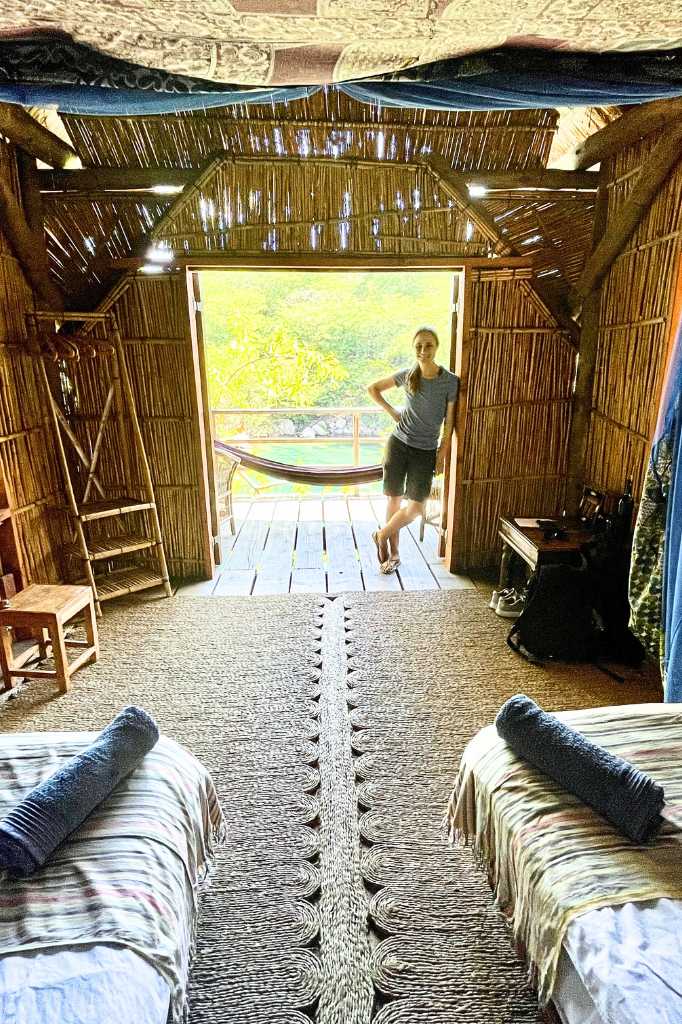
My personal inner sanctuary is a hammock. To be more precise: the hammock that hung in front of our little cabin in Malawi, Africa, in 2021.
I remember exactly how it felt — the gentle rocking, the warm air, my mind finally going quiet. That very special blend of lightness and stillness that I rarely find anywhere else with such clarity.
I now have a hammock hanging in my home office. Not as decoration — but so that I can return to that exact feeling at any time. Not as a luxury — but as a necessity.
And that’s exactly what I wish for you, too.
Mini meditation: Visit your inner sanctuary
Want to give it a try right now? Then take a few minutes just for yourself.
What place did you imagine and visit in your mind?
Movement as a path to your happy place
An inner sanctuary doesn’t only live in your mind — it can also be found in your body. Gentle movement is a wonderful way to anchor that sense of security and well-being physically.
Yin Yoga, a slow walk in nature, mindful stretching upon waking — these aren’t about performance. They’re acts of self-care. For your body. And for your nervous system.
Especially with fibromyalgia, it’s important to find and respect your own pace. Not what fitness apps tell you. Not what others can manage. But what feels right for you right now.
Let’s talk: together, we’ll figure out which types of movement work best for you, how to listen to your body — and how to find your own personal path.
Conclusion: Your happy place is always within reach
Even though fibromyalgia changes so much and makes things difficult — it can’t take away your inner sanctuary. It’s always there. You carry it with you.
The more often you visit it, the more familiar it becomes. And the easier it will be to turn to it in difficult moments — as a brief respite, a moment to breathe, a reminder that lightness is still possible.
You don’t have to figure fibromyalgia out on your own. If you’d like some support in discovering your own rhythm and sources of strength, I’m here for you.
👉 Ready to take the first step? Book a free initial consultation now, and let’s explore together how my one-on-one support or gentle movement can transform your life with fibromyalgia.
Mail from the Wellness Oasis
Receive valuable tips, exercises, and inspiration about fibromyalgia directly in your inbox. Sign up now and stay motivated on your journey to more ease and well-being!